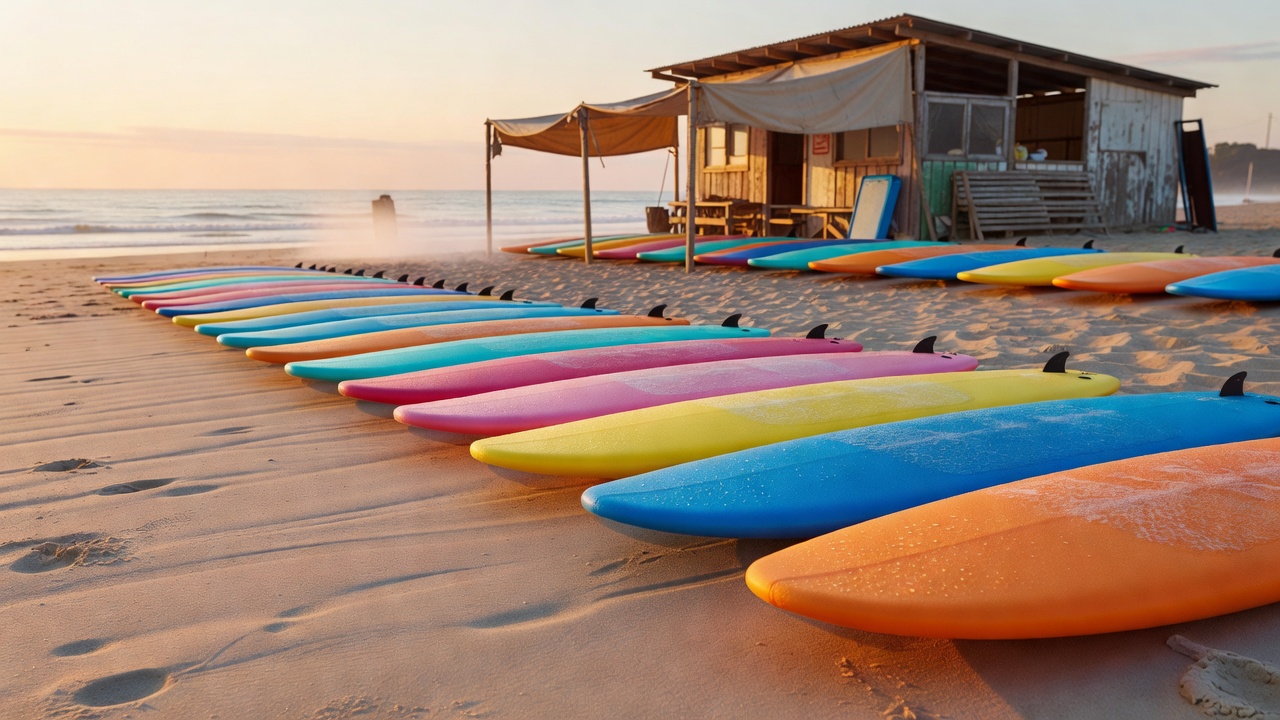
Why beginners start on a soft-top
A soft-top, often called a foamie, has a foam deck and usually a slick plastic bottom. It is long, wide and thick, which means three good things for you: it floats you high so paddling is easier, it catches small whitewater early, and it hurts far less when it bumps your shin or shoulder. Every reputable surf school, from Cornwall to Taghazout in Morocco to Santa Cruz in California, starts students on soft-tops for exactly these reasons.
Hard fibreglass or epoxy boards look exciting, but they are less stable, harder to paddle and can cause real injuries when they hit you. You will ride one eventually. Not this month.
Understanding volume
Volume is how much space a board takes up, measured in litres. More volume means more float. A beginner wants plenty of it, roughly enough litres to match or exceed your body weight in kilograms. Length, width and thickness all add volume, so two boards of the same length can feel very different. If you are choosing between two sizes, take the bigger one. Nobody has ever quit surfing because their first board floated them too well.
Board size by body weight
Use this table as a friendly starting point, not a rule. Fitness, age and how often you surf all play a part.
| Rider weight | Board length | Approx. volume | Notes |
|---|---|---|---|
| Under 50 kg | 7'0"–7'6" | 45–55 L | Children and lighter adults |
| 50–70 kg | 8'0" | 60–70 L | The classic school board |
| 70–85 kg | 8'0"–9'0" | 70–85 L | Go 9'0" if surfing rarely |
| 85–100 kg | 9'0" | 85–100 L | Wider outline helps |
| Over 100 kg | 9'0"–10'0" | 100 L+ | Look for extra thickness |
Leashes, fins and wax
Your leash connects board to ankle so it does not wash away and hit someone. Choose one about as long as your board; an 8 ft board pairs with an 8 ft leash. Attach it to your back foot. Check the cord and the Velcro cuff for wear before each session.
Most soft-tops come with soft, flexible fins that are kinder on feet and legs. Keep them. If your board has hard fins, ask the rental shop for soft ones. A thin coat of surf wax on the deck helps grip, even on foam, especially in warm water.
Rent first, buy later
For your first few sessions, rent from a surf school or beach shop. You will get the right size for the conditions, and staff can tell you where beginners surf that day. When you are ready to buy, mass-market soft-tops such as the 8 ft Wavestorm, or brands like Softech and Catch Surf, are affordable and tough. Second-hand boards are great value; check for deep dents, soft spots and peeling skin.
When to move on
Once you can catch unbroken green waves, angle along them and paddle out through small surf without struggling, you might move to a slightly shorter soft-top or a fibreglass mini-mal of around 7'6". Take it slowly. Dropping too much volume too fast is the most common reason improvers stop enjoying the water.